- TRAVEL GUIDES
arrow_drop_down
- Canada
- United States
- Sunny Destinations
arrow_drop_down
- VIEW ALL
- BUCKET LIST
- ABOUT
- CONTACT
Rome in a Day: Ultimate 1-Day Rome Itinerary
- Italy
- Rome
-
Nov 29
- Share post
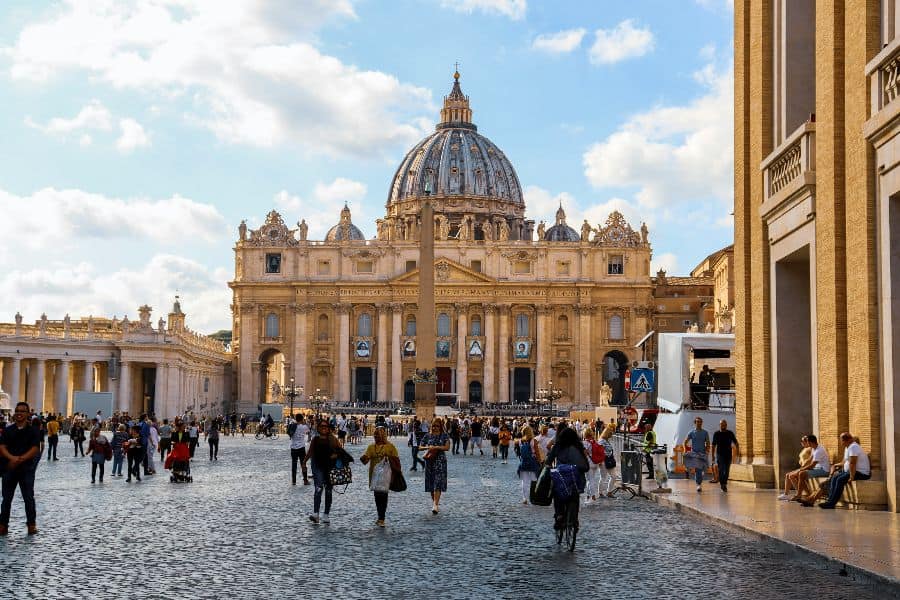
A well-planned Rome itinerary lets you hit the major landmarks while still having time to wander the streets and eat your weight in pasta.
If you’ve only got 24 hours, you can absolutely crush it. Here’s the ultimate guide on how to spend one day in Rome.
View this post on InstagramA post shared by Rome Travel Guide 🇮🇹 Hotels | Attractions | Tips (@unlimitedrome)
Morning in Rome:
Kicking off your Roman adventure at the ancient heart of the city means you get to beat the crowds and see the most popular attractions before the midday heat hits.
The Colosseum and Roman Forum
Booking skip-the-line tickets in advance will spare you from wasting precious hours at the Colosseum, especially in high season. Your ticket gets you into the Colosseum, Roman Forum, and Palatine Hill for the whole day.
The Colosseum once held up to 50,000 people, all coming to watch gladiator battles and wild animal fights. You can circle the arena floor and look down into the underground chambers where animals and fighters wait their turn.
Just across Via dei Fori Imperiali, the Roman Forum sprawls out. This was ancient Rome’s main plaza for over a millennium, where politicians gave speeches, merchants hawked their goods, and everyone gathered for big events.
Key Forum structures to see: Temple of Saturn with its eight columns, the Arch of Septimius Severus, the House of the Vestal Virgins, and the Via Sacra (main street) are all worth a look.
Palatine Hill and Campidoglio
Palatine Hill rises 40 meters above the Forum and gives you some of the best views of the ruins below and the city beyond. Rome’s wealthiest and emperors built their mansions here, and you can still spot some frescoes and mosaic floors if you poke around.
The word palace comes from the Palatine Hill, where emperors built their residences. Emperor Augustus built his home here in 27 BC, and later emperors kept expanding. At the top, the Farnese Gardens offer shaded paths and benches for a quick break.
After descending Palatine Hill, stroll along Via dei Fori Imperiali toward Piazza del Campidoglio. Michelangelo designed this elegant square back in the 1530s, and it sits on Capitoline Hill. The Cordonata staircase has a gentle slope for tired legs, flanked by two massive statues of Castor and Pollux up top.
The piazza’s geometric pavement circles a bronze statue of Marcus Aurelius on horseback (the original’s inside the museum nearby). This spot was once the political and religious heart of ancient Rome, and it’s still the city hall today.
Midday in Rome:
After a morning among ancient ruins, the afternoon is all about Rome’s most celebrated monuments and buzzing public squares.
The Pantheon
The Pantheon is an architectural marvel that’s been standing for 2,000 years. Step through its massive bronze doors and look up—you’re under the largest unreinforced concrete dome ever built.
The hole in the top, the oculus, lets in a shaft of natural light that moves across the marble floor. When it rains, water falls right through, but the floor has hidden drains. It’s oddly satisfying to see in person.
Inside, you’ll spot the tomb of Renaissance artist Raphael and Victor Emmanuel II, Italy’s first king. The Pantheon started as a temple to all Roman gods before becoming a church in 609 AD.
The Trevi Fountain
The Trevi Fountain is a beast, 86 feet tall and 161 feet wide, making it the biggest Baroque fountain in Rome. Water tumbles over sea gods and mythical creatures, all carved from blindingly white travertine marble.
It’s crowded, no matter what time you go. Tradition says one coin means you’ll come back to Rome, two coins and you’ll fall for someone, three and you’ll marry them. You toss with your right hand over your left shoulder, facing away from the fountain. The city scoops up about €1.5 million in coins each year, all going to charity.
View this post on InstagramA post shared by Italy Best | Italy Travel & Lifestyle (@italybestofficial)
Piazza Navona and Campo de’ Fiori
Piazza Navona sits on the site of an ancient Roman stadium, so it has a long oval shape. Bernini designed the Fountain of the Four Rivers in the center, with marble figures representing the Nile, Ganges, Danube, and Rio de la Plata.
The Sant’Agnese in Agone church faces the fountain, and there’s a bit of a baroque rivalry going on between Bernini and Borromini here. Street artists, musicians, and bustling cafés fill the square all day.
Just a short stroll away is Campo de’ Fiori, where the morning market gives way to aperitivo hour later. Grab a spritz, park yourself, and watch the world go by.
Afternoon in Vatican City:
The Vatican squeezes centuries of art into the world’s smallest country. You’ll wander through legendary museums, stare up at Michelangelo’s ceiling, and visit the largest church in Christendom before ending up at a medieval fortress by the river.
Vatican Museums and Sistine Chapel
Book your tickets ahead or you’ll be standing in line for ages. The Vatican Museums have over 20 collections stretched across nearly five miles of wall space.
Start at the Pinacoteca for paintings by Raphael, Leonardo da Vinci, and Caravaggio. The Pio-Clementine Museum is packed with ancient Greek and Roman sculptures like Laocoön and His Sons and the Apollo Belvedere.
The Gallery of Maps is worth a detour—40 massive frescoed maps of 16th-century Italy line the walls, and the ceiling is a showstopper. The Raphael Rooms include the School of Athens, which you’ll probably recognize even if you don’t know much about art.
The Sistine Chapel is the grand finale. Michelangelo painted 5,000 square feet of ceiling between 1508 and 1512, with those famous Genesis scenes and the iconic Creation of Adam. The altar wall’s The Last Judgment came 24 years later and packs in 300 figures.
St. Peter’s Basilica and St. Peter’s Square
St. Peter’s Basilica took over a century to finish and is still the biggest church building on the planet. Entry is free, but it’s separate from the museum tickets.
Bernini’s bronze baldachin soars above the papal altar. Michelangelo’s Pietà—he carved it at just 24—sits in the first chapel on your right. It’s the only piece he ever signed, apparently.
If you’re up for it, climb the dome for panoramic shots of Rome. There’s an elevator partway, but you’ll still have to tackle 320 steps. At the top, the dome rises 448 feet and the views are unbeatable.
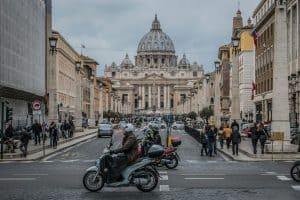
St. Peter’s Square sprawls out in front, with 284 columns in two semicircles. Bernini designed the plaza to fit a crowd, and an ancient Egyptian obelisk stands in the middle, brought to Rome in 37 AD.
Castel Sant’Angelo and Ponte Sant’Angelo
Castel Sant’Angelo is just a 10-minute walk from St. Peter’s Square along the Tiber. Emperor Hadrian built it as his tomb in 139 AD, but it later doubled as a fortress and papal hideout.
If time allows, tour the inside, but most one-day Rome itineraries just pause here for photos. The round building looks pretty epic at sunset with the statues all backlit.
Ponte Sant’Angelo, the pedestrian bridge, is lined with 10 marble angels by Bernini. Each holds a symbol from Christ’s Passion. The bridge itself dates to 134 AD and originally linked the city center to Hadrian’s tomb.
Evening in Rome:
Rome’s streets get a special glow as the sun dips and the crowds thin out. Golden hour makes ancient monuments look almost unreal, and locals spill into neighborhood piazzas for their evening passeggiata.
Piazza Venezia and the Vittoriano
Piazza Venezia, right in Rome’s core, is where several big roads tangle together. The massive white marble Vittoriano monument looms over the square, all columns and dramatic staircases.
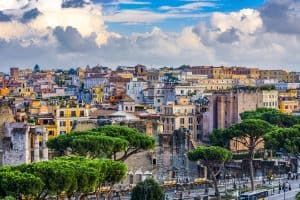
For a fee, you can take the elevator to the top of the Vittoriano and get a killer view over Rome’s rooftops. Up there, Rome sprawls out before you; the Roman Forum, Colosseum, and even St. Peter’s dome all pop into sight at once.
Piazza Di Spagna and the Spanish Steps
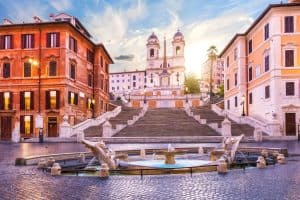
The Spanish Steps connect Piazza di Spagna with the Trinità dei Monti church perched above. Built in 1725, this 135-step staircase has a knack for drawing crowds, especially as the sun dips lower.
The church at the top shows off its twin bell towers and a proud obelisk, while the Barcaccia fountain below (shaped like a half-sunken boat) begs for a photo or two.
Via Condotti runs off from the piazza, stretching toward the river and stacked with high-end fashion boutiques. Window shopping here is free, and the scene stays lively well into the night.
Trastevere and Piazza Trilussa
Trastevere, just across the Tiber from Rome’s center, offers village vibes, tangled cobblestone alleys, and buildings draped in ivy or laundry, sometimes both.
Piazza Trilussa greets you at the end of Ponte Sisto bridge. Street musicians strum guitars or squeeze accordions while locals sip Aperol spritz at outdoor tables. The piazza’s fountain dates back to 1613, which feels about right for this neighborhood.
After 7 PM, the area fills up with Romans and students. The mood stays easygoing—more local hangout than tourist circus.
Sunset Bike Ride Along the Tiber River
The Tiber’s river paths are a break from the usual tourist hustle. Ponte Umberto I is a favorite crossing, with its old-school lampposts and a direct line of sight to St. Peter’s dome.
Starting near Castel Sant’Angelo, you can bike south along the river, passing under historic bridges and catching the sky’s colors ripple on the water.
The path links up several neighborhoods, so you can cycle from the Vatican area to Trastevere. Benches dot the way if you want to sit and watch boats drift past.
(